DoubleVerify's 2025 Global Insights Report, based on a survey of nearly 2,000 marketing and advertising decision-makers, found that campaign managers spend 26% of their working time, over 10 hours per week, on manual optimization tasks like bid changes and budget reallocations.
An AI marketing agent works differently than a simple automation script. It can interpret context, choose a next step, and take action across connected tools, all while staying inside boundaries the business sets.
This article covers practical use cases, a build roadmap, governance requirements, and how smaller businesses can start without replacing their existing team or stack.
Key Takeaways
- Use AI agents when work needs context and tool choice—not fixed-trigger automation
- First use cases should be repetitive, measurable, data-backed, and easy to escalate
- Prove one agent’s decisions before adding multi-agent orchestration
- Lock in approvals, permissions, and monitoring before consequential agent actions
What AI Marketing Agents Are—and How They Work
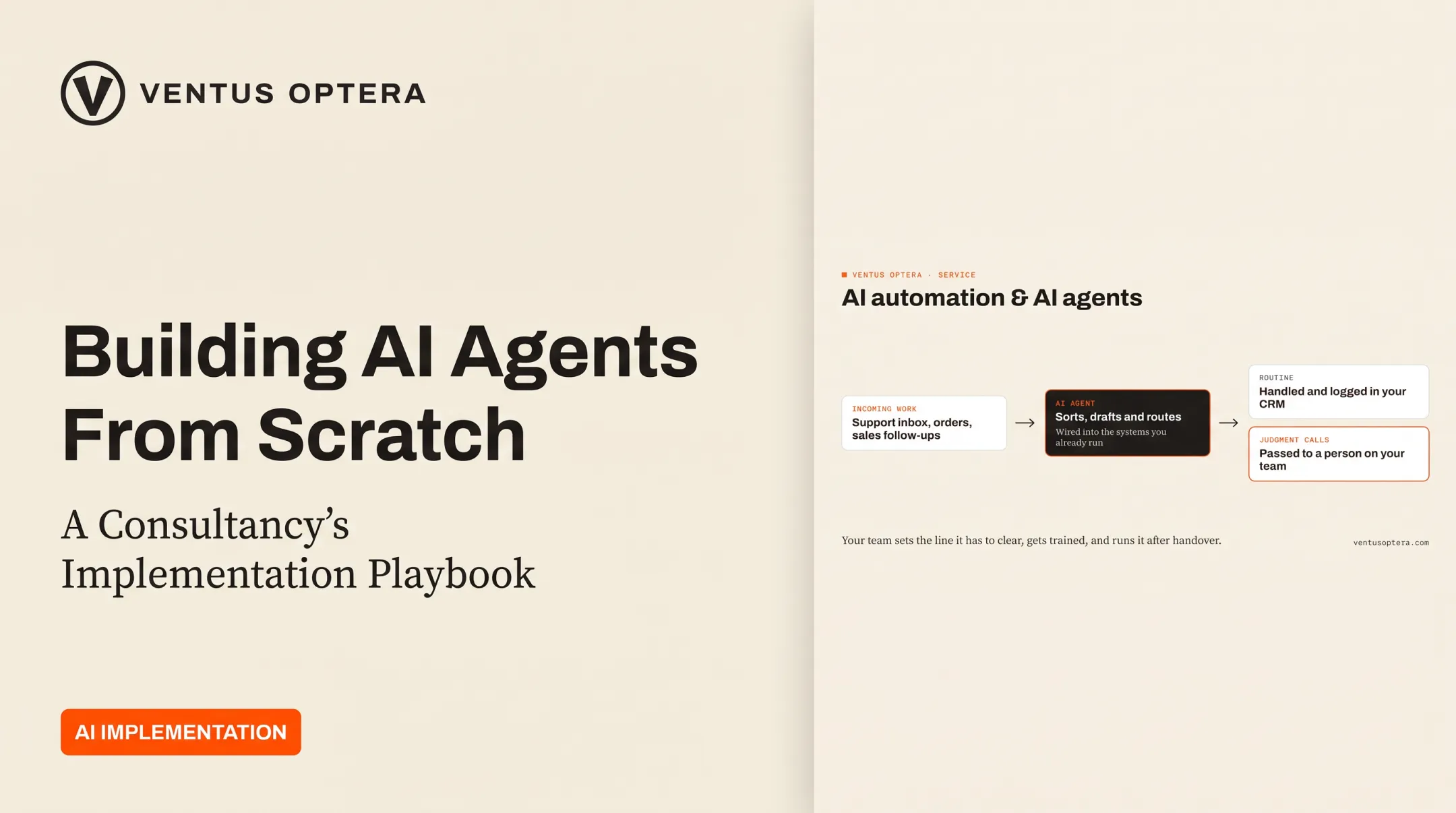
An AI marketing agent perceives information, reasons about a goal, and performs actions using tools: CRMs, email platforms, ad accounts, analytics systems, and content management systems. It's software that can move a workflow forward on its own, within limits you define.
Agents vs. Copilots, Chatbots, and Automation
These terms get used interchangeably, but they're not the same thing:
- Copilots generate suggestions when prompted. A person still drives every step.
- Chatbots mainly converse with users, often through scripted menus or rule-based responses.
- Rule-based automation follows predetermined triggers. If X happens, do Y. No judgment involved.
- Agents make bounded decisions and execute multi-step workflows, adapting as new information comes in.
The categories overlap in practice. The real question is whether the system can independently progress a workflow, or whether it just produces an answer and waits.
The Agent Loop in Action
Researchers who developed the ReAct framework describe agent behavior as a loop: reason about the task, take an action through a tool, observe the result, then reason again. Academic research on reasoning and acting in language models frames this as reasoning traces interleaved with actions, not a single scripted pass.

Applied to marketing, that loop looks like this:
- Perception – Collect campaign results, website behavior, CRM status, and customer signals
- Reasoning – Compare those signals against campaign goals, audience rules, and past outcomes
- Action – Draft or send content, update a record, route a lead, or request human approval
When to Use an Agent (and When Not To)
Agents make sense for ambiguous decisions, unstructured data, and workflows that need context. Simple, high-volume actions with fixed conditions, like sending a receipt after a form submission, are better handled with deterministic automation. Don't build an agent where a trigger will do.
Marketing AI Agent Use Cases That Deliver Practical Value
Rather than listing disconnected ideas, here's how agents fit into the actual marketing workflow, organized by the decision each one makes and where a human needs to step in.
Content and SEO Agent
This agent researches audience questions and content gaps, proposes briefs, drafts channel-specific content, checks brand and search requirements, then routes the work for approval.
A randomized academic study of 2,234 participants compared human-only and human-AI ad-creation teams. Human-AI teams produced 50% more ads per worker in the same time, with stronger ad copy and weaker images, and performed similarly overall in field testing.
That is controlled-experiment evidence, not a guarantee for every content team. The gains showed up most clearly in throughput, not every quality dimension.

Lead Qualification, Enrichment, and Sales Handoff Agent
Form submissions, website activity, CRM records, firmographic data, and engagement history feed a fit-and-intent judgment. The agent updates the CRM and prepares a concise handoff with supporting evidence and a recommended next step.
High-value or uncertain opportunities still route to a person. At Uber, a 130-person investigations program used a Slackbot called R2D2 to take over repetitive triage and answer from a knowledge base, freeing the team to handle judgment calls that actually needed a person.
Campaign Analytics and Optimization Agent
The agent pulls advertising, email, web, and CRM data together to answer recurring business questions, spot anomalies, and recommend budget, audience, creative, or timing changes.
Irreversible actions, like pausing a campaign or changing spend, should stay behind human approval until the agent has a track record of validated decisions.
Lifecycle Personalization and Nurture Agent
The agent re-evaluates stage from current behavior, selects the right message or asset, then pauses, advances, or re-engages the nurture path. Consent, frequency limits, and audience exclusions still apply.
During Samsung's Galaxy S20 launch, a sentiment-analysis program flagged at-risk live-chat customers in real time and routed them to senior agents, an example of behavioral signals triggering escalation rather than a scripted sequence.
Marketing Operations and Reporting Agent
This agent replaces manual spreadsheet consolidation. Typical work includes:
- Syncs CRM, advertising, support, and reporting data
- Generates recurring dashboards
- Alerts the team when a defined condition changes
For a small business, this is often the better starting point. It can begin with read-only access and draft recommendations rather than taking customer-facing action, which lowers the risk of a first deployment.
How to Build an AI Marketing Agent
Start with a workflow assessment, not a model selection exercise. Document the current process before you pick models or tools:
- Who's involved
- Which systems get touched
- Where handoffs happen
- Where delays occur
- What business outcome you're trying to improve
Define the Objective and Success Criteria
State the goal in operational terms. "Prepare qualified handoffs with supporting evidence" works. "Improve marketing" doesn't.
Before building anything, establish a baseline. Measure:
- Time spent on the current manual process
- Data-entry error rate
- Response speed to leads or customer actions
- Qualified opportunities generated per week
- Content throughput
- Reporting reliability
Prepare Information Sources and Tools
Identify authoritative data sources. Clean inconsistent customer and campaign data before connecting anything. Document field definitions, and separate reference data from sensitive data so you can set access permissions correctly.
Equip the agent with narrowly defined tools:
- Read tools for retrieving campaign and customer context
- Action tools for updating records or creating drafts
- Approval tools that pause before high-impact actions
Every tool needs a clear name, input validation, error handling, and logging. Define what happens when a system is unavailable or data is incomplete, because it will happen.
Write Instructions and Test Iteratively
Convert brand guidelines, campaign playbooks, qualification criteria, and escalation policies into explicit instructions with examples. Then test:
- Normal requests the agent should handle cleanly
- Ambiguous requests that need clarification or safe defaults
- Incomplete data scenarios where fields or context are missing
- Adversarial or out-of-scope requests the agent should refuse or escalate
Compare the agent's output against what a person would decide. Refine before expanding scope.
Single Agent vs. Multi-Agent Architecture
Once testing shows stable judgment, decide whether one agent is enough. Start with a single agent and a handful of well-defined tools. Add specialized research, content, analytics, or routing agents only when one agent's instructions or tool set becomes hard to manage. Most small businesses never need more than two or three agents working together.

Governance, Measurement, and Ownership
Agents need oversight built in from day one, not added after something goes wrong.
Where Human Review Is Non-Negotiable
Require review before:
- Publishing customer-facing content
- Changing budgets or ad spend
- Sending sensitive communications
- Modifying important CRM fields
- Taking any action that's costly or hard to reverse
Define escalation triggers in writing: low confidence, missing data, policy conflicts, repeated failures, or requests outside the agent's scope.
Guardrails That Matter
- Least-privilege permissions on every connected system
- Approval queues for consequential actions
- Rate limits and sensitive-data filters
- Audit logs and versioned instructions
- A documented rollback procedure
Technical controls are not enough on their own. US rules on commercial email, endorsements, and consumer data—CAN-SPAM opt-outs and California's CCPA among them—apply to agent-generated marketing the same way they apply to human work. An agent does not get a compliance exemption.
Measure Outcomes and Reliability Separately
Track business outcomes and agent reliability as separate scorecards:
Business outcomes
- Qualified pipeline
- Conversion quality
- Campaign efficiency
- Time saved
Agent reliability
- Tool errors and unsupported answers
- Escalation rate and approval rate
- Latency
Compare both against a documented baseline, not a vendor's marketing claim.
The 10/20/70 Rule, Correctly Defined
Boston Consulting Group's 2019 framework describes AI success as 10% algorithms, 20% technology, and 70% business-process transformation. BCG's 2024 update keeps the same split: 10% algorithms, 20% technology and data, 70% people and process.

A capable model alone will not fix the hard parts:
- Poor or incomplete data
- Unclear ownership
- Fragmented systems
- A team that has not adopted the new workflow
At Uber, better analytics and a redesigned escalation process cut critical security-escalation time-to-solve in half—not the model by itself.
Getting Started with Ventus Optera
Small and mid-size businesses don't need a fully autonomous, customer-facing agent on day one. They need AI embedded into the work they're already doing, not another disconnected tool bolted on top of the stack.
Ventus Optera, founded by Michael O'Brien after a decade of operations work at Uber, iAdvize, and Boston Dynamics, takes a practical path:
- Assess current workflows and rank opportunities by business value, complexity, data readiness, and risk
- Design and build a targeted AI-enabled application, dashboard, CRM integration, API, or client-facing workflow around the company's actual process
- Test it alongside the team, refine the operating model, and support ongoing improvements
A typical engagement starts with a fixed-scope project, often around four weeks, and is tested against agreed pass/fail criteria before any decision to expand.
The ownership distinction matters. Clients keep the software and data built for them, reducing dependence on spreadsheets and disconnected systems.
Before you assume a custom agent is the answer, evaluate whether your first move should be a custom workflow, an existing platform configuration, or a simpler automation. Building isn't always the right call, and an honest assessment should say so.
Frequently Asked Questions
How can AI agents be used in marketing?
AI agents support content and SEO drafting, lead qualification and sales handoff, campaign analytics, lifecycle personalization, and cross-system reporting. Human oversight remains essential for approvals and judgment calls.
What is the 10/20/70 rule for AI?
BCG's original framework attributes AI success to roughly 10% algorithms, 20% technology, and 70% business-process transformation, later updated to combine people and process into that 70%. The point is that technology alone rarely drives results.
What is the difference between an AI marketing agent and marketing automation?
Marketing automation follows fixed triggers and conditions set in advance. An AI agent interprets context, chooses among tools, and adapts its actions within defined constraints rather than following a static script.
What should a business's first AI marketing agent do?
Pick a repetitive, measurable, low-to-moderate-risk workflow with reliable data, such as reporting, lead routing, content briefs, or campaign anomaly alerts. Avoid starting with customer-facing, irreversible actions.
What data and integrations do AI marketing agents need?
They typically connect to CRM, campaign, website, advertising, and content data. Data quality, access permissions, consent management, and a clearly defined source of truth matter more than the number of integrations.
Do AI marketing agents replace marketing employees?
No. Agents reduce repetitive work and improve team effectiveness, while people retain responsibility for strategy, judgment, creativity, relationships, approvals, and exception handling.