Introduction
"AI consulting" means different things to different providers. One quote covers a 30-minute advisory call. Another covers a four-week custom build with CRM integrations and staff training.
Comparing those two numbers as if they're the same service is how small business owners end up either underbudgeting for integration work or overpaying for a custom system they didn't need.
The confusion is real: a readiness audit can run $497, while a full implementation can land between $20,000 and $50,000 depending on scope. Neither figure tells you what you'll actually spend unless you know what's included.
This guide breaks down current U.S. pricing by engagement type, what each price tier covers (and excludes), how to estimate a realistic budget for your workflow, and the ownership questions most proposals skip entirely.
Key Takeaways
- Pricing runs from $497 single-workflow audits to $50,000+ custom builds, plus $3,500–$10,000/month retainers.
- Complexity drives cost more than the AI label: data quality, integrations, and support needs matter most.
- One defined workflow often fits a fixed-scope project; multi-department work usually needs a larger build.
- Fund the lowest cost that produces a measurable result and leaves your team able to run the system.
How Much Does AI Consulting Cost for Small Businesses?
There's no standard price list for AI consulting, and that's not a dodge. Published figures vary by consultant seniority, region, technical complexity, and whether you're buying advice, a build, or ongoing support.
The table below reflects currently posted U.S. provider pricing (checked in 2026). Treat these as quote comparisons, not historical averages.
| Engagement Type | Typical U.S. Price | What's Usually Included |
|---|---|---|
| Hourly/one-off advisory | Varies; request a written cap | A specific question answered, no deliverable system |
| Readiness audit or opportunity assessment | $497–$8,500 | Workflow mapping, prioritized fix list, ROI estimates |
| Fixed-scope implementation ("quick win") | $15,000+ | One automated workflow, basic testing, light training |
| Custom AI application or multi-workflow project | $20,000–$50,000 | Integrations across systems, data cleanup, documentation, training |
| Monthly managed support or fractional leadership | $3,500–$10,000/month | Ongoing execution, monitoring, strategic advising |
The catch: a low published price often covers strategy only. A higher price may bundle implementation, integrations, training, documentation, and a defined support window. Compare deliverables line by line, not headline fees.
Illustrative example: Say a 12-person company wants to automate document intake into its CRM. A readiness audit ($1,500–$3,500) identifies the workflow and recommends build-versus-buy.
If a custom build is justified, implementation (including CRM integration, data cleanup, and training) might run $15,000–$30,000, plus any software subscriptions. This is an example, not a quote; your actual number depends on your systems and data.

Ventus Optera structures this exact decision as two separate fixed-scope steps: an AI opportunity assessment first, then a process automation build only if the numbers justify it.
What Is Included in AI Consulting Costs?
A consulting engagement can run through several phases: discovery, prioritization, strategy, implementation, training, and handoff. Not every engagement includes every phase, which is why two quotes with the same dollar figure can deliver very different results.
Discovery, Readiness, and Prioritization
Before recommending any tool, a consultant should map your repetitive work: spreadsheets, disconnected systems, bottlenecks, and where sensitive data lives. This step produces a prioritized opportunity list that keeps the first spend tied to measurable work.
Why it matters:
- Prevents paying for experiments that never deliver value
- Defines a smaller, lower-risk first project
- Separates "AI could theoretically help here" from "this is worth fixing first"
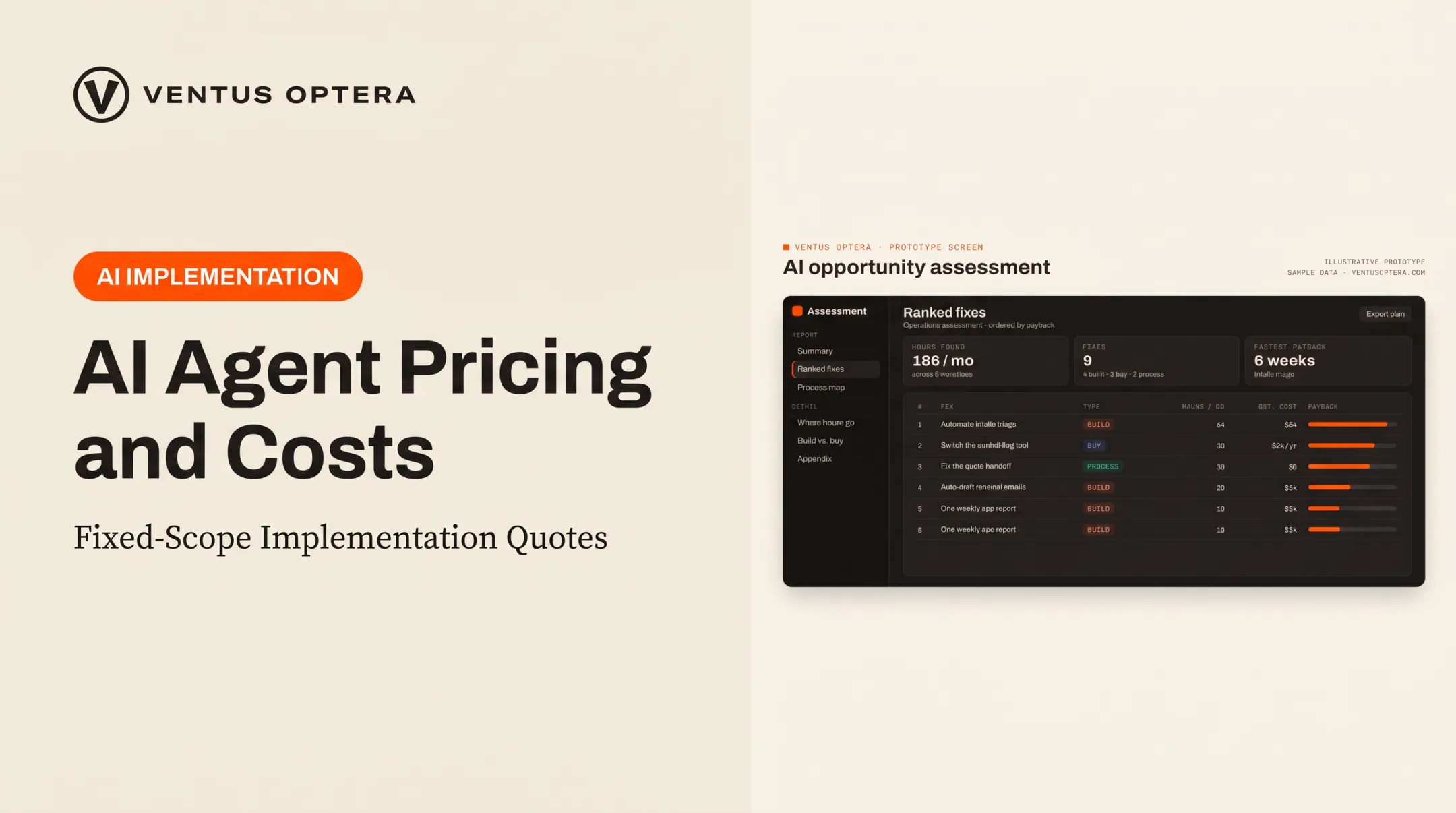
That ranked list should state what each fix costs, what it saves, and whether it is a build, a buy, or a process change with no software at all. Ventus Optera's AI opportunity assessment is built this way, and the plan stays with the client regardless of who implements it.
Strategy, Tool Selection, and Build-vs-Buy Guidance
Not every workflow needs custom software. Sometimes a CRM feature you're already paying for solves the problem. An independent recommendation should weigh:
- Subscription cost versus one-time build cost
- Integration effort and data portability
- Vendor lock-in risk
- Your team's actual capacity to maintain the solution
Growing businesses are far more likely to report an integrated technology stack than declining ones: 66% versus 32% in one Salesforce survey of SMB leaders. That figure is a correlation, not proof that integration alone drives growth, but it is a solid reason to inventory your systems before you request a fixed quote.
Implementation, Integration, and Data Preparation
This is where costs often balloon past expectations. Connecting AI to your CRM, support desk, billing system, or document storage can cost more than the AI tool itself, especially when:
- Records are inconsistent across systems
- APIs are limited or poorly documented
- Permissions and security controls need rebuilding
Ventus Optera's 2024 support-center rebuild for Boston Dynamics connected Salesforce, Jira, Paligo, and Docebo under ITAR and US/EU compliance constraints. Integration work, not the AI itself, was the bulk of the lift.
Data cleanup, prompt design, testing, human review, and error handling are distinct tasks. They belong in the proposal, not assumed as "included."
Training, Ownership, and Post-Launch Support
Staff training, documentation, and troubleshooting shouldn't be treated as implied extras. A proposal that skips them is cheaper for a reason.
Ask whether training, handover, and post-launch troubleshooting are line items, and who owns the code and data after go-live. Ventus Optera includes staff training and handover with its automation builds, and clients retain ownership of the code and data from day one. Pricing and outcomes still vary by project scope.
Low-Cost vs High-Cost AI Consulting Engagements — What's the Difference?
Lower-cost and higher-cost engagements solve different problems. Price is only the surface difference.
Lower-Cost Engagement
This tier suits a business with:
- One clearly defined question
- A straightforward tool-selection decision
- Public or low-risk data
- An employee who can own execution after the consultation wraps
Expect a diagnosis, not a delivered system. A $497–$1,500 audit tells you what to fix. It doesn't build the fix.
Higher-Cost Engagement
A larger budget is justified when AI needs to:
- Connect several systems (CRM, billing, support, advertising)
- Process sensitive or regulated documents
- Support multiple teams rather than one person
- Replace a manual report someone rebuilds by hand every week
A bigger budget should buy more than extra features. Before you sign, require:
- Measurable success criteria
- Documented workflows and defined training
- Clear ownership terms and a stated support boundary
- An honest plan for what happens if the pilot misses its target
Unclear value is exactly why larger builds stall. Gartner's 2024 research predicted that at least 30% of generative AI projects would be abandoned after proof of concept by the end of 2025, with poor data quality and fuzzy ROI as leading causes. Treat that forecast as a scope check, not a scare statistic, before you fund a full build.
How to Estimate the Right AI Consulting Budget
Start with the business problem, not the AI feature. Identify the task, the current process, who's involved, which systems touch it, how often it happens, and where it breaks.
Estimate the opportunity's value using real baselines:
- Labor hours currently spent
- Turnaround time and rework costs
- Missed follow-ups or lost capacity
- Revenue delayed by the bottleneck
Don't assume every saved hour becomes cash savings — some hours get reallocated, not eliminated.
Separate costs by type:
- One-time: discovery, configuration, development, integration, data cleanup, testing, training
- Recurring: software licenses, API/usage fees, hosting, monitoring, periodic reviews
- Internal: staff time for approvals, testing, and adoption
- Contingency: unclear requirements or legacy-system surprises
Ask every vendor for a written scope that covers:
- Deliverables and milestones
- Assumptions and change-request rates
- Support period and renewal terms
- Ownership of code and data
- What happens if the pilot misses its success criteria
Recommended sequence: validate one high-value workflow, measure it against a pre-project baseline, then decide whether to expand, buy a broader platform, or stop.

Ventus Optera follows this staging: assessment first, then process automation only if the numbers justify it. Monthly executive coaching is available for leaders who want ongoing build-versus-buy guidance.
What Most Businesses Miss When It Comes to AI Consulting Cost
Owners often budget for the consultant's project fee and stop there. That's the mistake.
Easy to overlook:
- Software subscriptions and API consumption fees
- Data cleanup and internal implementation time
- Training, maintenance, and security reviews
- Future integration changes as systems get added
The cheapest quote can become the most expensive one if it excludes documentation, monitoring, human review, or post-launch support. When comparing proposals, check for these omissions explicitly. Don't assume they're bundled in.
Ownership is non-negotiable. Confirm in writing who owns:
- Custom code and workflow configurations
- Prompts and documentation
- Accounts and business data
Ventus Optera's model, where clients keep the code, data, and accounts and can hand them to any developer they hire, is one example of an ownership-oriented approach, not an industry standard. Ask explicitly; don't assume.
Before you fund a build, confirm two things:
- The underlying workflow and data are suitable for a custom system
- Any generic chatbot is accurate, handles privacy, and is something your team will adopt
Demand for implementation help is real. Upwork reported 60% year-over-year growth in AI-related freelance work volume in 2024. That demand is not proof every project reaches production.

Ask for references showing completed, maintained systems, not just prototypes.
Conclusion
AI consulting costs for small businesses span a wide range, from a few hundred dollars for a focused audit to tens of thousands for a custom, multi-system build. Scope, integration work, data readiness, and support determine what you actually pay.
A practical path forward:
- Define one costly workflow worth fixing
- Establish a baseline before you spend anything
- Request comparable, itemized proposals
- Start with the smallest engagement that answers your question
- Expand only after the solution proves its value
Owners who want a strategic framework beyond pricing can read The AI Strategy Blueprint by John Byron Hanby IV. The publisher presents it as a guide for leading AI transformation, and it is a useful next step once your first pilot has data behind it.
Frequently Asked Questions
How much does AI consulting for small businesses cost?
Prices range from roughly $497 for a single-workflow audit to $50,000+ for a multi-system custom build, with monthly retainers running $3,500–$10,000. Scope, integrations, and ongoing support change the final number significantly.
What does an AI consultant actually do?
A consultant assesses your workflows, prioritizes opportunities by ROI, and recommends build-versus-buy decisions. In full-scope engagements, they also implement, integrate, train your team, and measure results after launch.
What is the best AI tool or agent for small businesses?
There's no universal answer. The right tool depends on your workflow, data sensitivity, existing systems, and who will maintain it. Evaluate the problem first; pick the tool second.
Are AI consultants in high demand?
Yes. Upwork reported 60% year-over-year growth in AI-related work volume in 2024. But widespread experimentation isn't the same as successful production deployment, so vet for completed, maintained projects.
How can small businesses use AI to generate $10,000 a month?
No source guarantees a specific revenue figure. Pick one measurable use case (lead response, sales capacity, or retention), validate its financial impact on a small scale, then decide whether to scale it.