Many teams struggle here. They move from a single ChatGPT prompt straight into "build an autonomous agent" without a clear plan for tool access, error handling, or exit conditions. That jump is where costs spike and failures get hard to trace.
Businesses are shifting from isolated LLM prompts toward AI-enabled workflows that update CRMs, retrieve documents, and complete multi-step work unattended. That shift raises the stakes on getting the architecture right.
This article compares the main design patterns, clarifies their trade-offs, and shows how to pick the simplest architecture that reliably gets the job done.
Key Takeaways
- A design pattern is an architectural approach, not a model or framework.
- Start with a single-agent loop like ReAct before adding orchestration layers.
- Four pattern groups cover most use cases: structured workflows, planning systems, multi-agent orchestration, and reflection loops.
- The right pattern depends on predictability, tool access, risk, latency, and budget.
- Guardrails, logging, and clear ownership matter as much as model choice.
What Is an AI Agent Design Pattern and Why Does It Matter?
What is an AI agent design pattern?
A design pattern is a repeatable way to arrange an LLM, its instructions, available tools, memory, workflow logic, evaluators, and human handoffs so the system can complete a defined goal.
This is different from an AI agent type. Types describe capabilities or autonomy level. Patterns describe how the components actually interact: what calls what, in what order, and under what conditions.
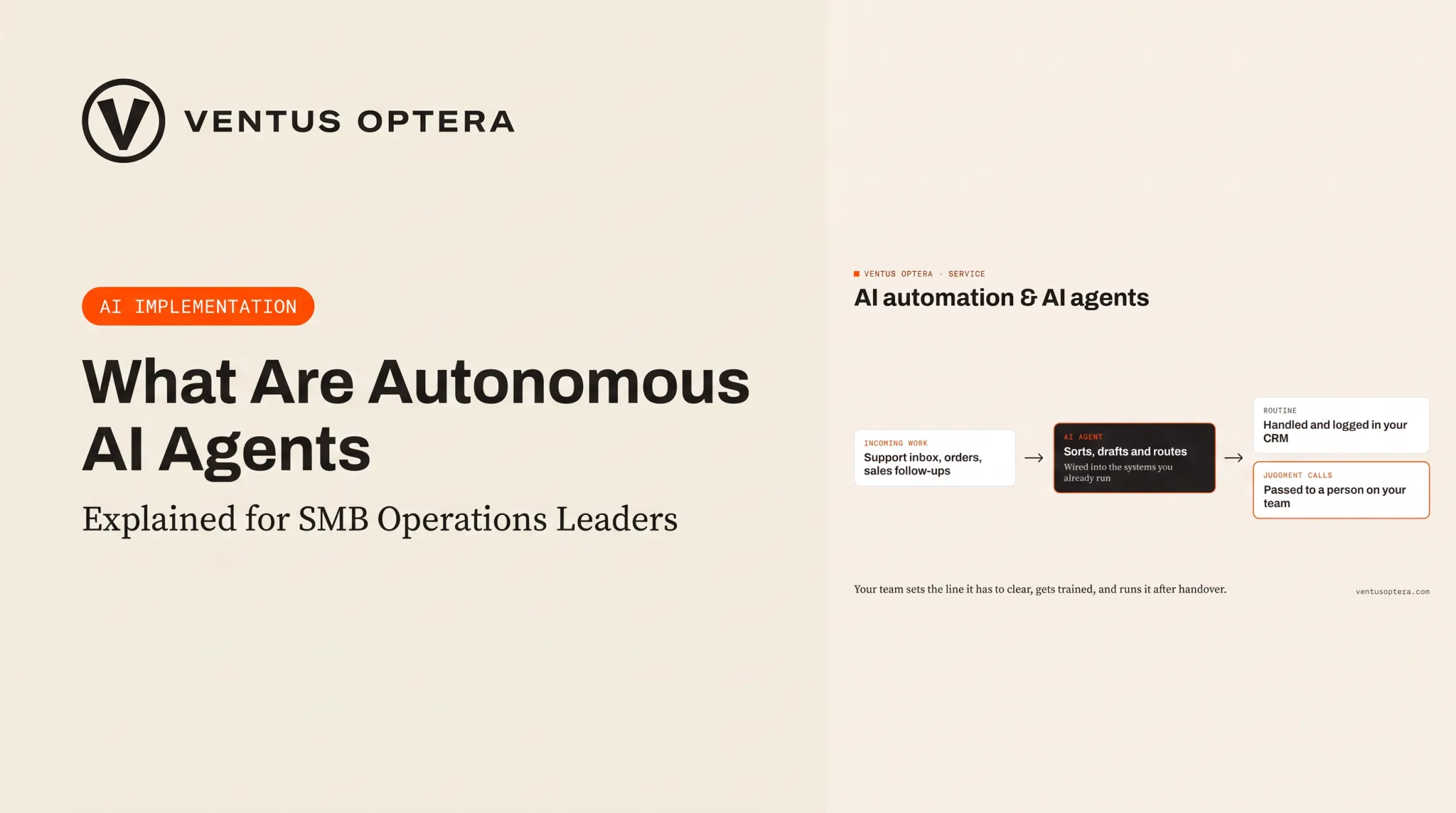
A chatbot answering a single question isn't necessarily an agent. OpenAI's framing is plain: an agent uses the model to control workflow execution and decisions. It loops through outputs, tool calls, and handoffs until it reaches an answer, a pause, or a failure state. A single-turn response without that control loop doesn't qualify.
Why are design patterns important?
Patterns connect directly to practical outcomes:
- Predictable execution: you know roughly what the system will do before it does it
- Easier testing: bounded steps are easier to evaluate than open-ended reasoning
- Clearer debugging: you can trace which step failed and why
- Controlled system access: tools get scoped permissions instead of blanket access
- Better scalability: adding volume doesn't multiply unpredictable behavior
Skip the intentional design and you tend to get repeated tool calls, unclear ownership between components, inconsistent outputs, and costs that climb without anyone noticing until the invoice arrives.
Anthropic's engineering guidance is blunt about the starting point: optimize a single, well-tested LLM call first, and only add multi-step workflows or autonomous agents when evaluation shows a clear benefit. Complexity should be earned, not assumed.
That principle shows up in how AI actually gets deployed inside real companies. At Uber, a Slackbot called R2D2 took over the repetitive parts of investigations triage (a 130-person program running from 2014 to 2017) by answering from a knowledge base and routing anything unclear to a human.
That's a bounded pattern doing one job well, not an open-ended autonomous system.
Types of AI Agent Design Patterns
These patterns are composable, not rigid categories. A production system might combine routing, planning, tool use, and human approval in a single workflow.
Single-agent loop patterns
The ReAct (reason-act-observe) pattern has the agent interpret a goal, select a tool or action, receive an observation, and decide what to do next.
Yao et al.'s original research found this interleaving of reasoning and action helped the model revise its plan mid-task and handle exceptions that a fixed script would miss. On FEVER fact-checking, it reached 60.9% accuracy versus 56.3% for standard chain-of-thought prompting.
This pattern suits bounded workflows:
- Retrieving CRM information before answering a question
- Checking a document or policy before responding
- Answering a support question using a knowledge base
- Updating a record through a controlled, permissioned API
Trade-offs: ReAct is simple to implement and easy to iterate on. The flip side is latency from repeated tool calls, error accumulation across turns, and a real risk of the agent looping. Set a maximum-turn limit and retry caps before you ship anything.

Structured workflow and planning patterns
| Pattern | How it works | Best fit |
|---|---|---|
| Prompt chaining | Fixed sequence; each output feeds the next step | Extract, classify, validate, produce |
| Routing | Classify input, send to a specialized path | Requests with genuinely different categories |
| Parallelization | Run independent subtasks concurrently, aggregate | Independent reviews or research tracks |
| Plan-and-execute / ReWOO | Build the full plan upfront, then execute | Dependencies that can be anticipated in advance |
| Orchestrator-workers | Central agent decomposes, delegates, synthesizes | Multi-source research, cross-system updates |
Plan-first approaches like ReWOO skip repeated large-model calls at every step by building a blueprint with placeholders for prior results. The original ReWOO paper reports this cuts token usage dramatically: 1,986 tokens versus ReAct's 9,795 tokens on the same HotpotQA benchmark.
But the same paper flags the weakness: a plan made upfront can fail when the environment can't be anticipated and the agent discovers something mid-task that invalidates its assumptions.
Orchestrator-workers patterns fit situations like researching several external sources and merging findings, or coordinating updates across multiple internal systems where a central agent needs to decide how to split the work.
Multi-agent, reflection, and critique patterns
Two structures dominate multi-agent setups:
- Manager pattern — one coordinating agent calls specialist agents as tools and retains ownership of the final answer
- Decentralized handoffs — specialist agents transfer full control to each other, each owning its segment of the conversation
Multi-agent designs earn their complexity when:
- Domains are clearly separated
- A single agent's toolset has grown unwieldy
- Permissions differ between tasks
- Distinct specialist perspectives add real value
Evaluator-optimizer loops add a second model call that checks the first output against explicit criteria before revision. This mirrors a pattern Ventus Optera builds into its own process: define what you're building and how you'll judge success before development starts, so the evaluation criteria aren't improvised after the fact.
Advanced search patterns like Tree of Thoughts or LATS exist for hard search problems, but they add real implementation and evaluation overhead. Tree of Thoughts researchers reported 74% accuracy on a Game of 24 benchmark versus 4% for standard chain-of-thought. That's a striking number, but one measured on three narrow tasks, not a general productivity claim.
More agents is not automatically better. Anthropic reported a 90.2% improvement on its internal research evaluation from a multi-agent configuration, but noted that setup used roughly 15 times the tokens of a simple chat interaction.
A separate 2025 academic study found multi-agent planning performance 39% to 70% lower than a single-agent baseline on different task types. Whatever architecture you're evaluating, compare it against a reproducible baseline before you trust the claim.
How to Choose the Right AI Agent Design Pattern
The right pattern comes from the workflow's requirements and risk profile, not from a trending framework or a sophisticated-sounding architecture.
Purpose and predictability
Start by asking whether the workflow has a known sequence of steps.
- Deterministic code or prompt chaining when the process is stable and repeatable
- Agent loop when the next step depends on context or tool results
Define the desired outcome, acceptable failure modes, and measurable success criteria before picking an architecture, not after the build is underway.
Complexity, tools, and scale
Assess a few concrete factors:
- How many tools does the agent need, and how similar are they?
- How much unstructured information is involved?
- Can subtasks run independently, or do they have sequential dependencies?
- What's the expected volume, latency tolerance, and model cost budget?
Smaller, simpler components that meet your evaluation target beat impressive ones that don't.
Risk, permissions, and human involvement
Classify every tool by what it can actually do:
- Read-only access — generally lower risk, still worth auditing
- Record changes — moderate risk, needs validation
- External communications — higher risk, reputational exposure
- Financial actions — high risk, needs approval gates
- Irreversible operations — highest risk, human sign-off required
Decide upfront where human approval, escalation, audit logs, and confidence checks sit in the workflow.

Build-versus-buy and ownership
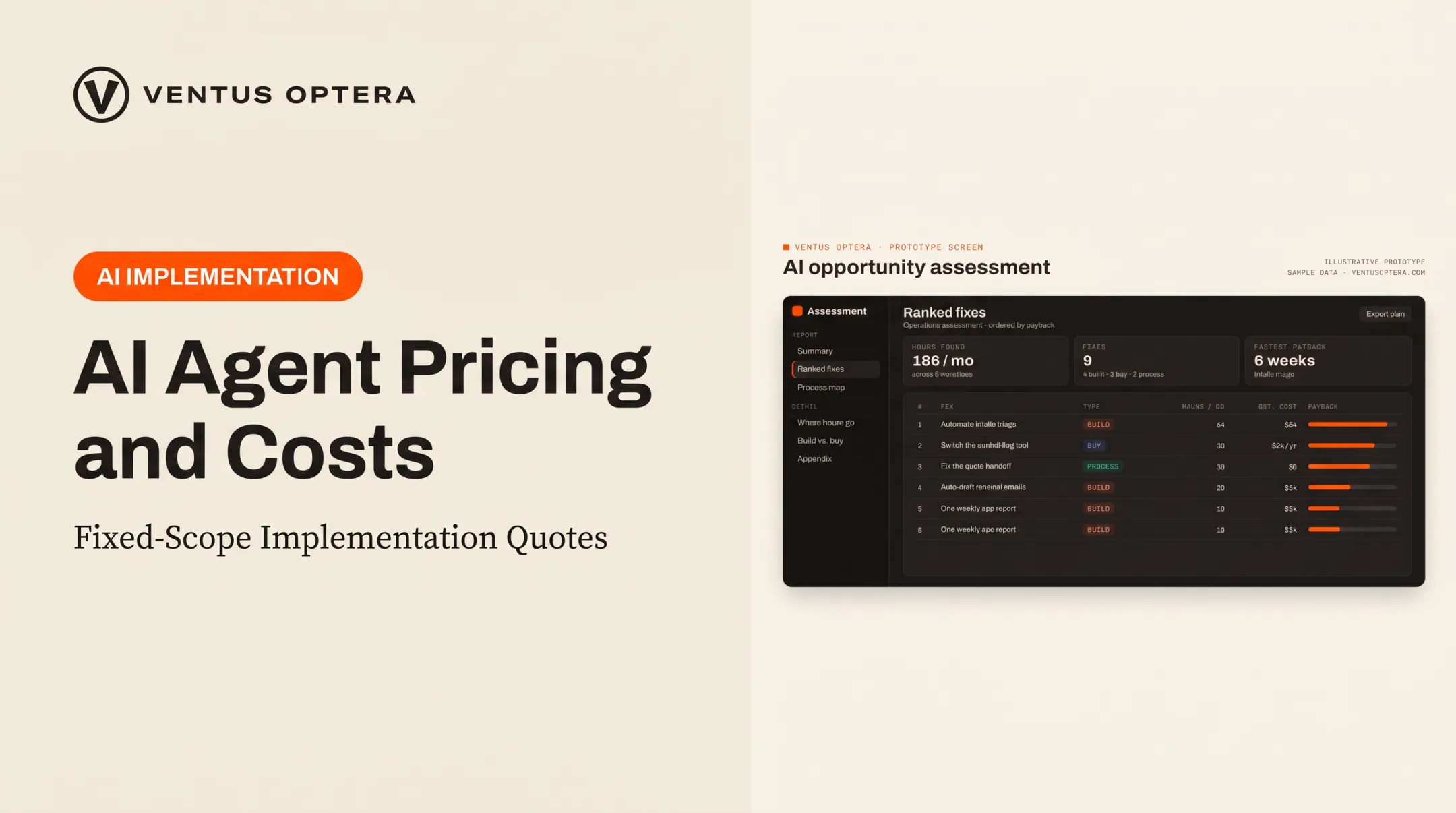
Before assuming an autonomous agent is the answer, ask whether an existing platform or a lighter integration solves the problem more durably. Ventus Optera typically starts here: assess the workflow, rank AI-enabled improvements by payback, and recommend a build, a buy, or a process change—whichever is the cheapest fix that lasts. When a build is warranted, the work is scoped around how the business already operates, and clients own the software and data from day one.
What to Check Before Finalising an AI Agent Design Pattern
What to Check Before Finalizing an AI Agent Design Pattern
Don't reach for the most advanced architecture when a deterministic workflow or a single well-scoped agent meets the goal. Before launch, work through this checklist:
- Operational trade-offs — additional model calls, agent handoffs, and parallel branches all affect latency, cost, reliability, and how traceable failures are
- Tool scope — every tool needs a narrow purpose, clear parameters, documented failure states, and permissions that match its actual risk
- Evaluation cases — test normal requests, ambiguous inputs, missing data, tool failures, prompt injection attempts, repeated loops, and escalation scenarios
- Stopping conditions — retry limits, traceable logs, output validation, and a defined human handoff path
- Data ownership — privacy, access controls, vendor lock-in, and long-term maintainability before committing to a framework
A software or agent decision is often a three-year commitment made during a six-week sales cycle.
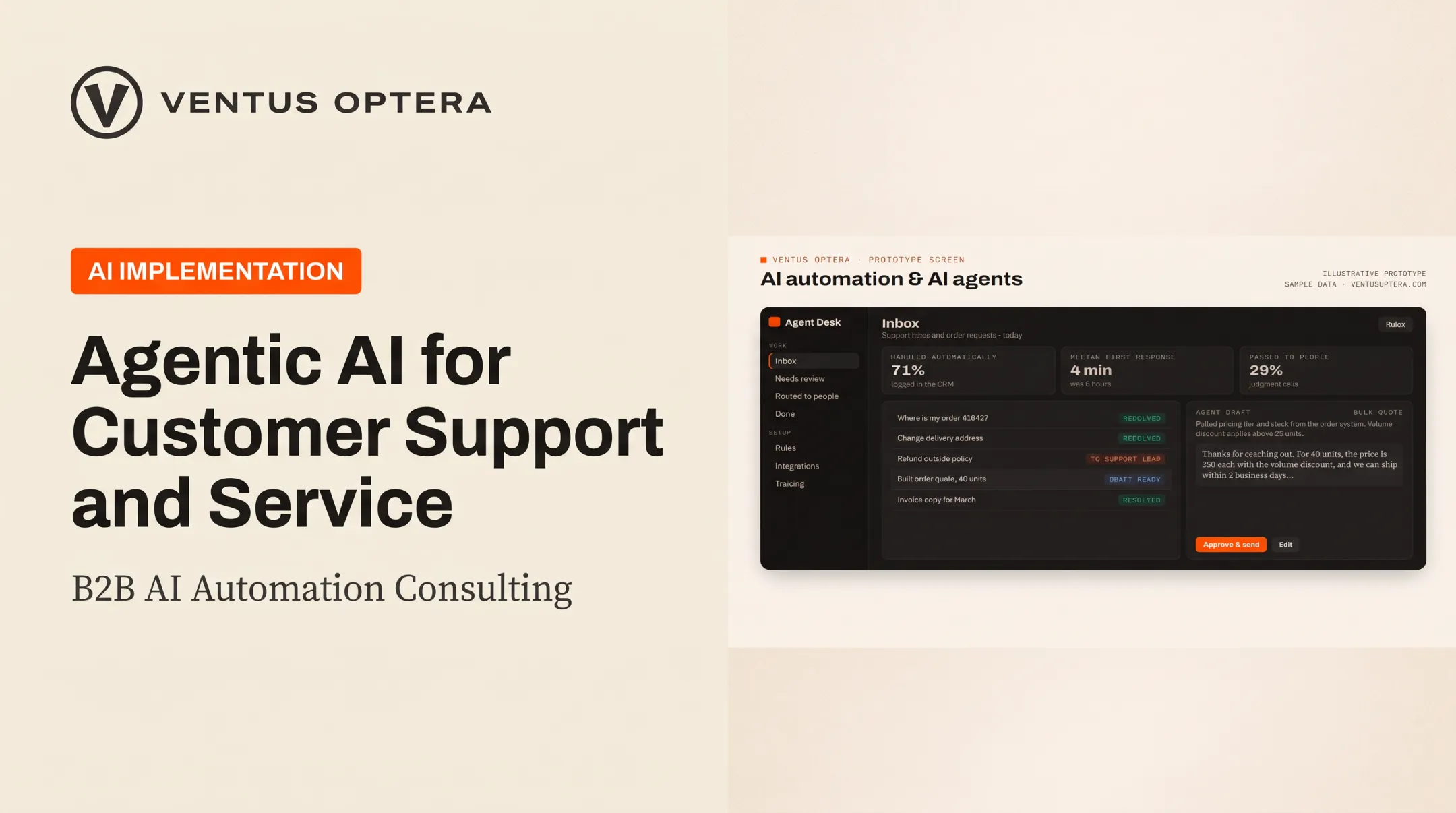
Ventus Optera's AI opportunity assessments provide ROI-ranked recommendations specifying build, buy, or process-change paths. Its automation engagements define the AI-to-human handoff point in writing before anything goes live, and every unanswered question is logged for review.

Production readiness means ongoing monitoring and iteration, not a one-time prompt design exercise.
Conclusion
AI agent design patterns give you practical blueprints for connecting models, tools, planning, orchestration, evaluation, and human oversight. No single pattern is inherently better than the others. Each one fits a different class of problems.
The strongest starting point is usually the simplest architecture that reliably completes the workflow. Add complexity only when testing shows a clear benefit—not because a more elaborate setup looks more impressive.
Thoughtful workflow assessment, measurable evaluation, and accountable implementation beat chasing maximum autonomy. Build the agent your workflow needs, then prove it works.
Frequently Asked Questions
What are the main AI agent design patterns and types?
The main groups are single-agent loops like ReAct, structured workflows such as routing and prompt chaining, planning patterns like plan-and-execute or ReWOO, multi-agent orchestration, and reflection or evaluator-optimizer loops.
What is the difference between an AI agent and an AI agent design pattern?
An agent is the system actually performing the work. A design pattern is the architectural method used to organize its reasoning, tools, memory, delegation, and stopping conditions.
What is the ReAct design pattern?
ReAct interleaves reasoning, action, and observation in a loop: the agent thinks, acts, observes the result, and decides what to do next. It's useful when the next step depends on tool results or changing context.
When should a business use a single-agent pattern instead of a multi-agent system?
Use a single agent when one model with clear instructions and tools can handle the workflow. Multi-agent designs make sense when responsibilities, domains, permissions, or workstreams are genuinely distinct.
How do I choose the right AI agent design pattern?
Evaluate workflow predictability, tool count, parallelism, latency tolerance, cost, risk level, human approval needs, and your team's capacity to test and maintain the system over time.
How can AI agent design patterns be made safer and more reliable?
Use narrow tool permissions, structured outputs, defined evaluation tests, audit trails, retry and turn limits, prompt-injection defenses, and human approval before high-impact or irreversible actions.