Introduction
For years, AI meant typing a question and getting an answer back. That's changed. Now AI can pursue an outcome: plan a sequence of tasks, call the tools your business already uses, and take approved actions without someone typing every step.
That shift matters most for companies stuck in repetitive, multi-step work across disconnected systems — a CRM here, a billing tool there, a support inbox nobody fully trusts. But "autonomous" doesn't mean unsupervised. The agents working inside real businesses today operate inside boundaries someone defined in advance.
In McKinsey's 2025 survey, 23% of respondents said their organization was scaling an agentic AI system in at least one business function, with another 39% experimenting. That's meaningful adoption, not universal deployment.
This article covers what these agents are, how they actually work, the main types you'll encounter, where businesses are using them, and what responsible implementation looks like.
Key Takeaways
- Autonomous AI agents chase human-set goals: observe data, reason, use tools, act, then check results.
- An LLM handles reasoning and language; the agent is the system around it—tools, memory, permissions, and workflow logic.
- Best fit: bounded, measurable processes with limited authority and clear escalation paths.
- Clean data, careful integrations, and human accountability before any consequential action.
What Are Autonomous AI Agents?
An autonomous AI agent is a software system that interprets a goal, breaks it into tasks, chooses actions, and works with connected tools or systems. It keeps working with limited step-by-step human direction, more like a junior employee who takes an objective and runs with it until something requires a judgment call.
Core characteristics include:
- Goal orientation: works toward an outcome, not just a single response
- Multi-step planning: breaks a broad request into ordered subtasks
- Tool use: calls APIs, queries databases, updates records
- Memory or context: retains relevant information across steps
- Feedback and adaptation: adjusts its plan when new information arrives
- Escalation awareness: stops or hands off when conditions exceed its authority
Agents vs. LLMs, Chatbots, and Rule-Based Automation
These terms get used interchangeably, which causes confusion. They aren't the same thing.
| System | What it actually does |
|---|---|
| Large language model (LLM) | Generates or interprets text and code. NIST describes it as predicting the next token; it doesn't independently execute a business workflow. |
| Chatbot or copilot | Waits for a user prompt and assists with one task at a time. |
| Rule-based automation (RPA) | Follows fixed if-then paths; breaks when the situation falls outside the script. |
| Autonomous agent | Uses a model to direct workflow decisions and dynamically select tools within defined goals and guardrails, per Anthropic's criterion for agentic systems. |
The practical difference: an agent can keep working after you hand it an objective. A chatbot can't.
Autonomy Is a Spectrum
Autonomy isn't binary. It ranges from scripted workflows, to agents that plan within a narrow domain, to systems with broad decision-making authority. Most business deployments sit in the middle.
Before anything goes live, you should define:
- Which systems the agent can access
- What actions it's permitted to take
- Spending or communication limits
- Approval checkpoints and escalation conditions
How Do Autonomous AI Agents Work?
Strip away the hype and the agent loop is straightforward: receive a goal, gather context, plan, act, check the result, then repeat or escalate.

The Agent Loop in Practice
Take a request like "resolve this customer issue." An agent breaks it down:
- Identify the account and pull relevant records
- Check the contract and billing history for context
- Review prior communication to avoid repeating resolved issues
- Propose a response or take the approved action
- Update the ticket and log what happened
At each stage, the agent gathers context from CRM records, support platforms, documents, or APIs, then reasons about the next move. If a tool returns unexpected information, such as an account flagged for a billing dispute, the agent revises its plan rather than barreling ahead.
What's Under the Hood
A model alone isn't a complete agent. Reliable autonomy depends on the system wrapped around it:
- Reasoning engine (the model itself)
- Instructions and policies defining scope
- Memory for short-term context plus persistent knowledge
- Orchestration layer coordinating steps
- Connected tools for retrieval and action
- Identity and permissions controlling access
- Logging and monitoring for traceability
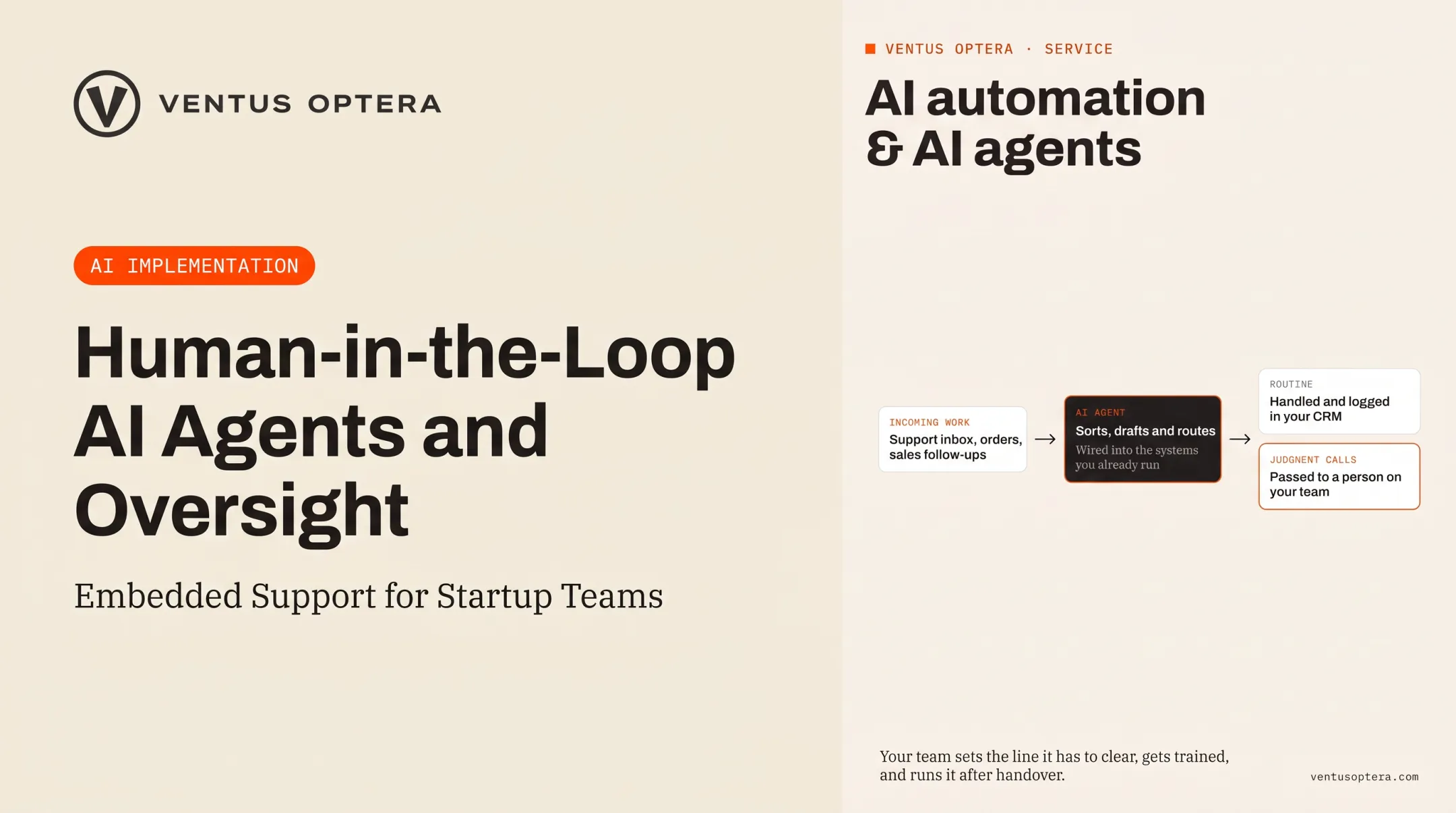
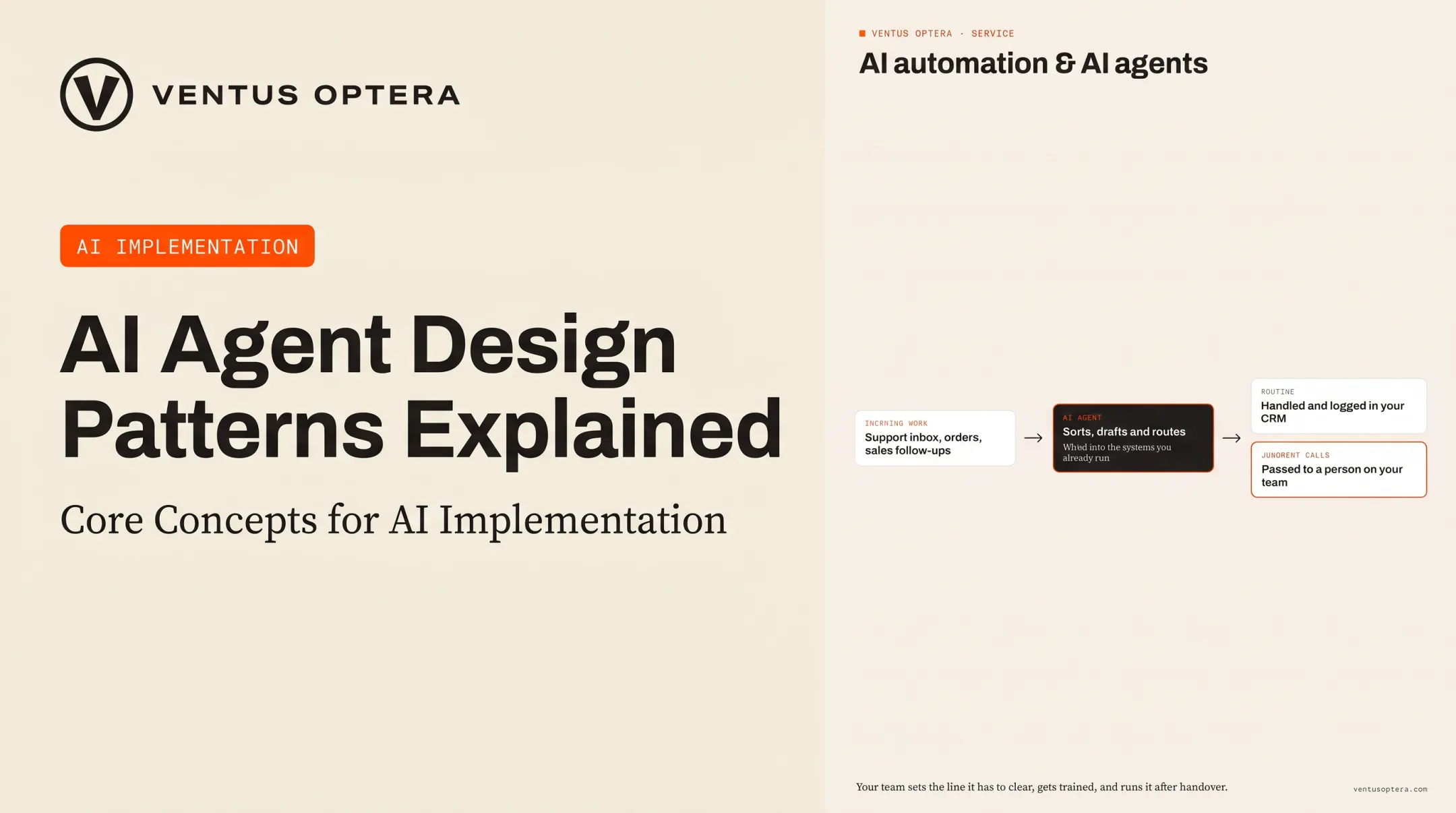
Ventus Optera's work with small and mid-size businesses follows this pattern directly: agents that sort a support inbox, copy order details into a CRM, and send follow-ups, wired into systems the business already runs rather than a standalone chat window bolted on top.
The same loop applies to inbound leads. An agent checks CRM data, drafts a follow-up, updates the opportunity record, and routes edge cases (an enterprise inquiry or a pricing objection) to a salesperson rather than guessing.
Types of Autonomous AI Agents
There's no single, standard list of "seven types" of AI agents. Classifications vary by decision logic, learning ability, autonomy level, or system architecture.
Russell and Norvig's foundational AI textbook outlines four classical agent-program designs; IBM uses five; others add hybrid and multi-agent categories on top. The table below groups common types by how each one decides what to do next.
| Type | How it decides |
|---|---|
| Simple reflex | Reacts to current input using fixed rules; no memory of history |
| Model-based | Maintains an internal model of its environment to handle incomplete information |
| Goal-based | Chooses actions that move toward a specified objective |
| Utility-based | Weighs options against criteria like cost, speed, or risk |
| Learning | Improves behavior using feedback and new data over time |
| Deliberative/reasoning | Plans and evaluates multiple steps before acting |
| Hybrid/multi-agent | Combines fast reactions with planning, or coordinates specialized agents for research, analysis, and execution |
In practice, a real business build often spans several of these at once: a learning, goal-based agent on a hybrid architecture, for example. The labels matter less than the decision logic behind the agent you're evaluating.
How Businesses Can Use Autonomous AI Agents
Agents earn their keep on workflows that are repetitive but not fully predictable, span multiple tools, and produce a measurable outcome. A process that's identical every single time probably just needs simpler automation.
Where this plays out across departments:
- Operations and admin — consolidate contract terms, billing details, and change histories; flag missing information; route exceptions for review
- Sales and marketing — monitor lead activity, draft personalized outreach, update CRM stages, and flag stalled deals, without unrestricted sending or budget authority
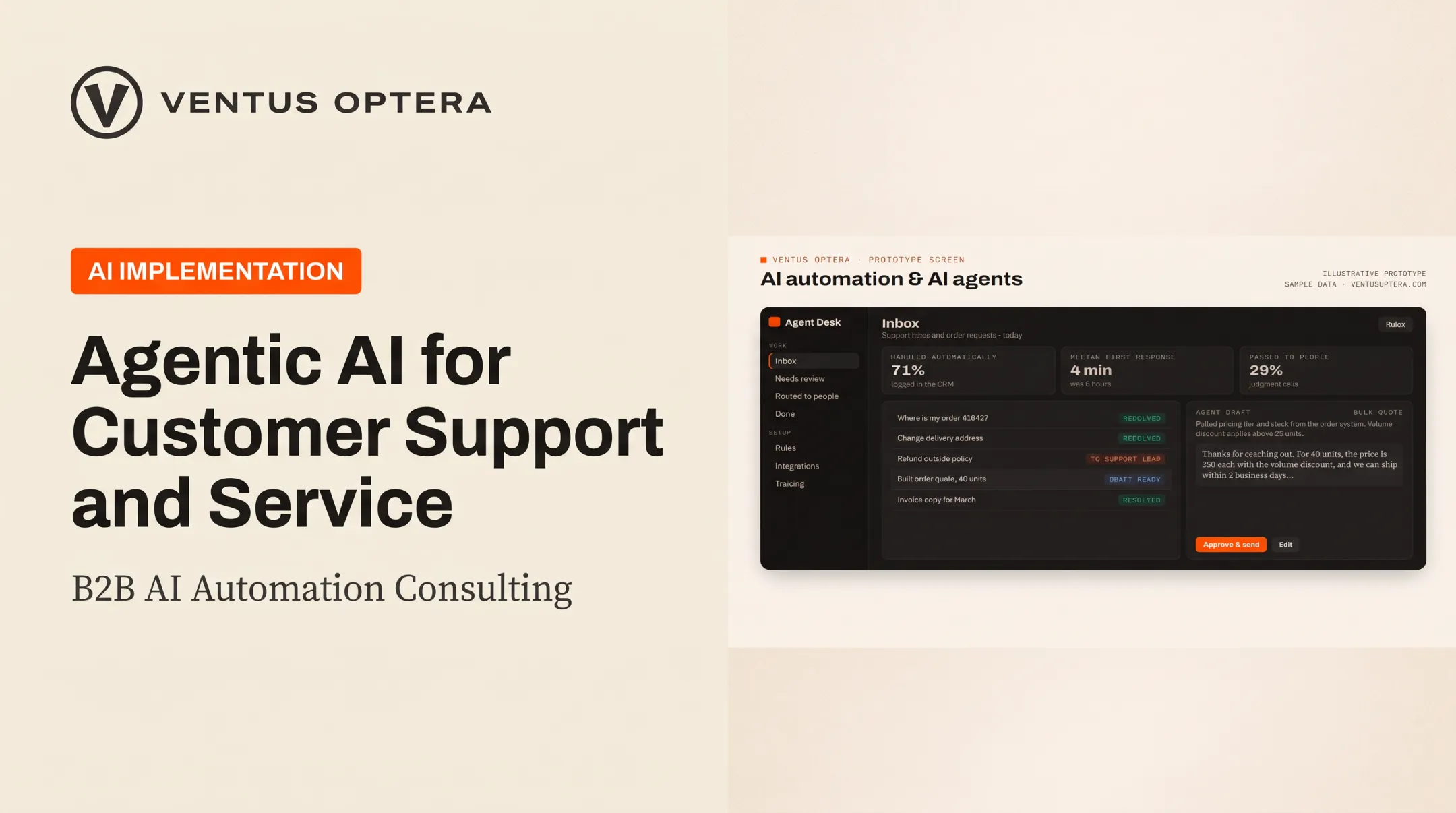
- Customer support — classify incoming requests, pull account context, suggest answers, escalate anything sensitive or ambiguous
- Finance and reporting — reconcile data from approved sources, prepare recurring summaries, flag anomalies for a human to decide on
- Product and engineering — summarize feedback, create backlog items, run tests, draft proposed fixes while keeping human approval on production changes
Real deployments back this up. Salesforce reported that its Agentforce deployment on its own Help site handled more than 500,000 conversations and resolved over 84% of incoming questions. That number is Salesforce's own self-reported figure, not a cross-industry benchmark.

The same pattern shows up in production support systems. An agent can look up an order, apply a change, and hand off to a person the moment a case is out of its depth. Agree the handoff line in writing before launch, and log every unanswered question for later review.
Gains worth expecting:
- Less manual coordination between systems
- Faster response cycles
- Fewer handoff errors
- Better visibility across tools that don't talk to each other
The value comes from fixing the end-to-end workflow, not from dropping a chat window onto a process that was already broken.
Implementing Autonomous AI Agents Responsibly
Before granting any agent broad authority, run it through a readiness check.
- Start narrow. Pick one workflow, one objective, a baseline, and a success measure. Don't hand over broad authority before you understand how the agent behaves.
- Audit your data. Check accuracy, freshness, ownership, access permissions, and conflicting records before the agent touches anything.
- Map every tool connection. Assign least-privilege permissions, action limits, approval checkpoints, and escalation rules for each integration.
- Test the edge cases. Normal requests are easy. Test ambiguous inputs, missing data, integration outages, and repeated failures before launch.
The real risks show up fast if you skip that work:
- Hallucinated actions
- Stale context
- Prompt injection
- Excessive access and privacy exposure
- Cascading failures when one tool fails mid-task
- Unpredictable costs
Gartner has warned that over 40% of agentic AI projects will be canceled by the end of 2027, citing escalating costs, unclear business value, and inadequate risk controls. It also cautions against relabeling a chatbot as an "agent" without the capability to back it up.

Operational safeguards worth building in from day one:
- Action logs and traceability for every decision the agent makes
- Human review gates for high-impact or irreversible actions
- The ability to interrupt or roll back an agent mid-task
- Regular evaluations against the original success measure
- A named owner accountable for outcomes, not just the technology
Those same checks shape how Ventus Optera approaches the work. An AI opportunity assessment maps where the hours go and ranks which fixes are worth building first. Then a process automation or custom integration is built around how the business already operates, not a generic platform forced onto it.
The right call is often the cheapest fix that actually lasts. Sometimes that means buying an existing platform, sometimes simplifying a process, and sometimes owning a custom build. Adopting an agent because the technology exists isn't a strategy.
Frequently Asked Questions
What are the 7 types of AI agents?
Taxonomies vary by source, but seven commonly referenced categories are: simple reflex, model-based, goal-based, utility-based, learning, deliberative/reasoning, and hybrid or multi-agent systems. Real implementations often combine several of these.
Is ChatGPT an agent or LLM?
ChatGPT is primarily an LLM-powered conversational application. OpenAI has since introduced an optional agent mode that selects tools and takes action, but ordinary ChatGPT conversation is not autonomous workflow execution.
How do autonomous AI agents work?
They cycle through observing information, reasoning about next steps, planning, acting through connected tools, evaluating the result, and either continuing or escalating to a human, all within boundaries set in advance.
What is the difference between an AI agent and an autonomous AI agent?
"AI agent" is a broad category covering anything from simple rule-followers to complex planners. Autonomous agents specifically operate with more independence across multiple steps, needing less ongoing direction from a user.
What are examples of autonomous AI agents?
Examples include customer support agents that resolve tickets and escalate exceptions, CRM agents that research and qualify leads, finance agents that reconcile transactions, and coding agents that improve test coverage. These typically operate with bounded authority.
Are autonomous AI agents safe for business use?
Safety depends on the guardrails around the agent: least-privilege access, monitoring, testing against edge cases, audit logs, and approval gates for sensitive actions. Risk comes from the implementation, not from the technology alone.